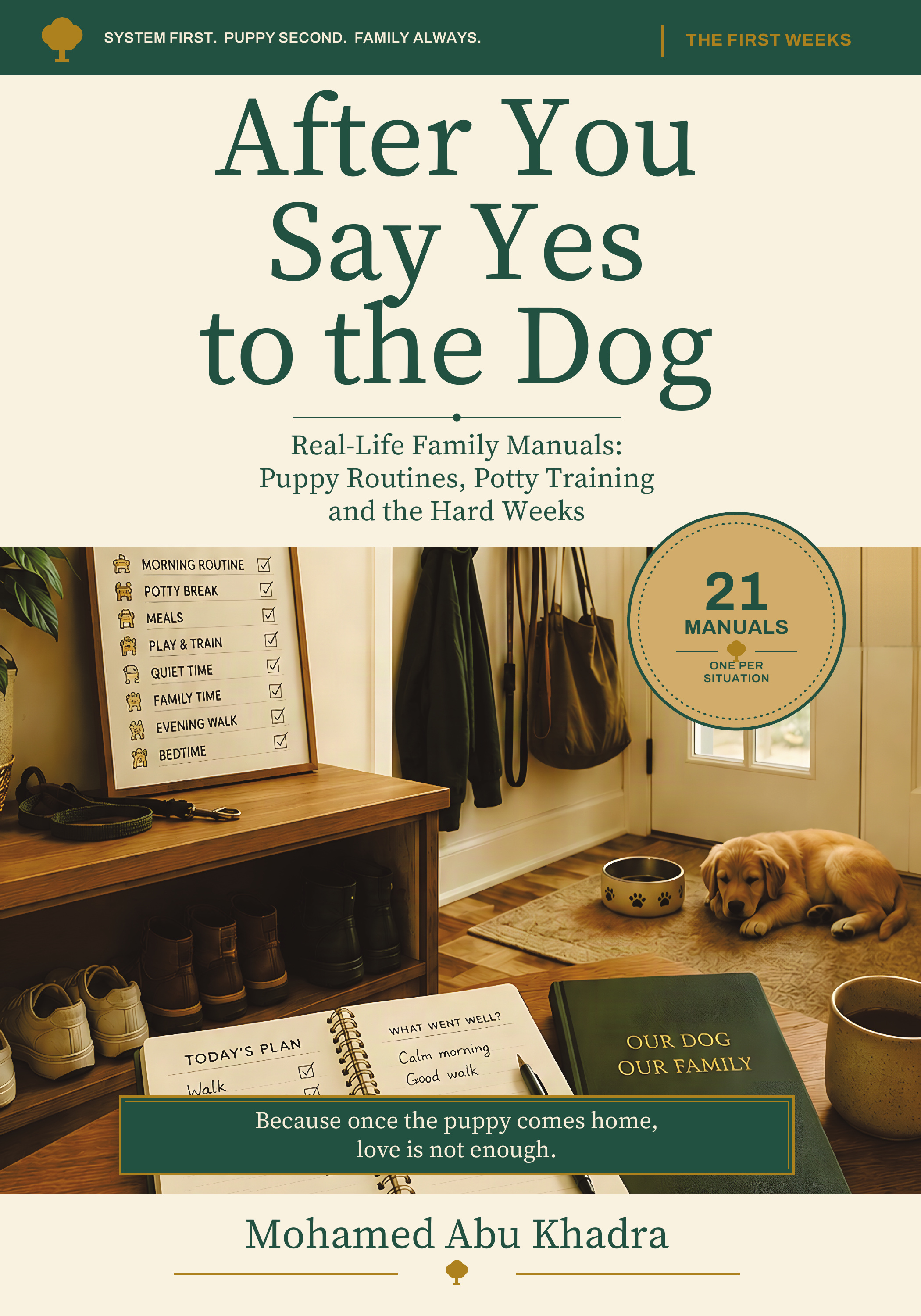
Everything you need to write about, review, or feature the books is on this page. If something is missing, write to me and I’ll send it the same day. Booking a talk instead? See Speaking.
The books
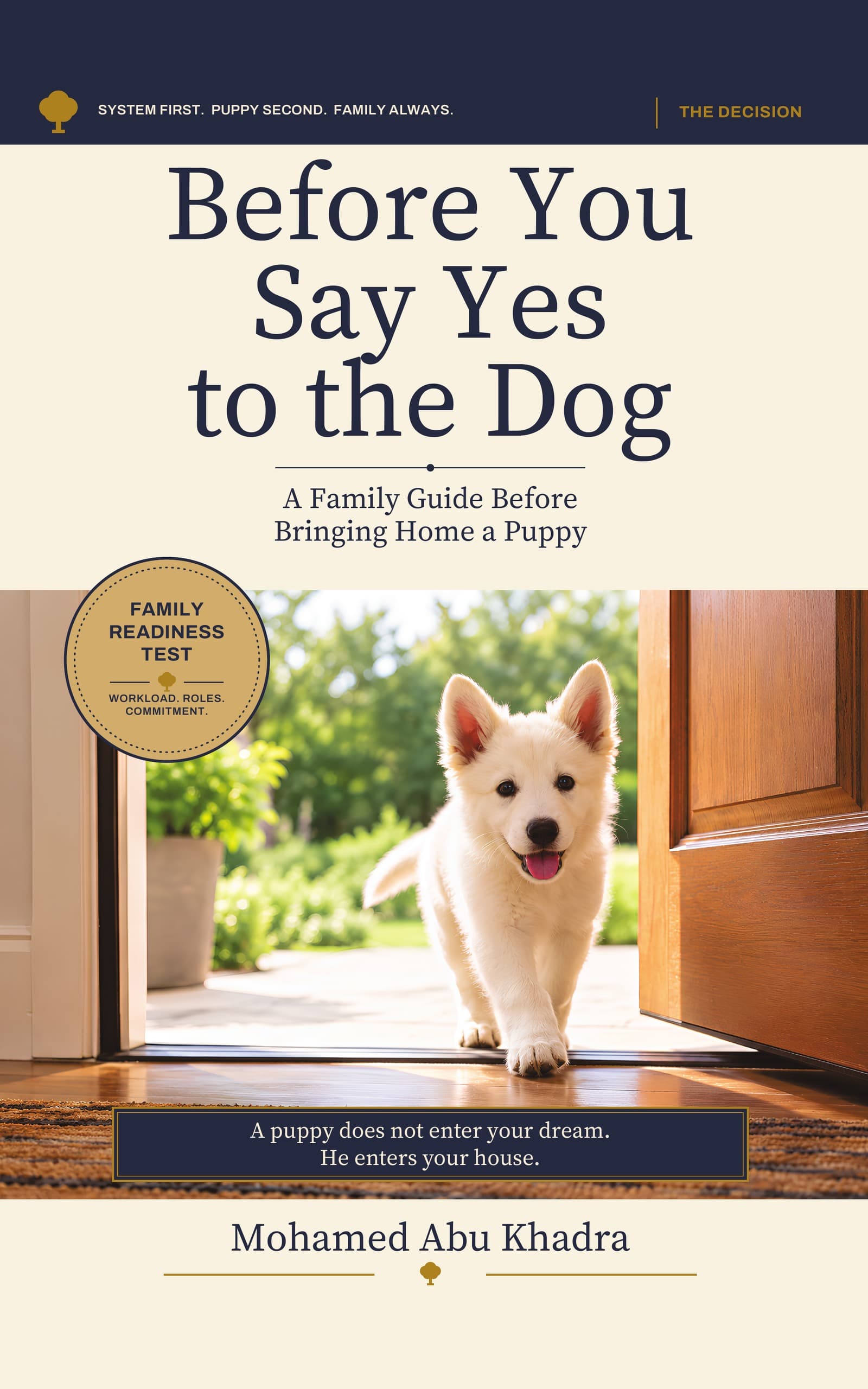
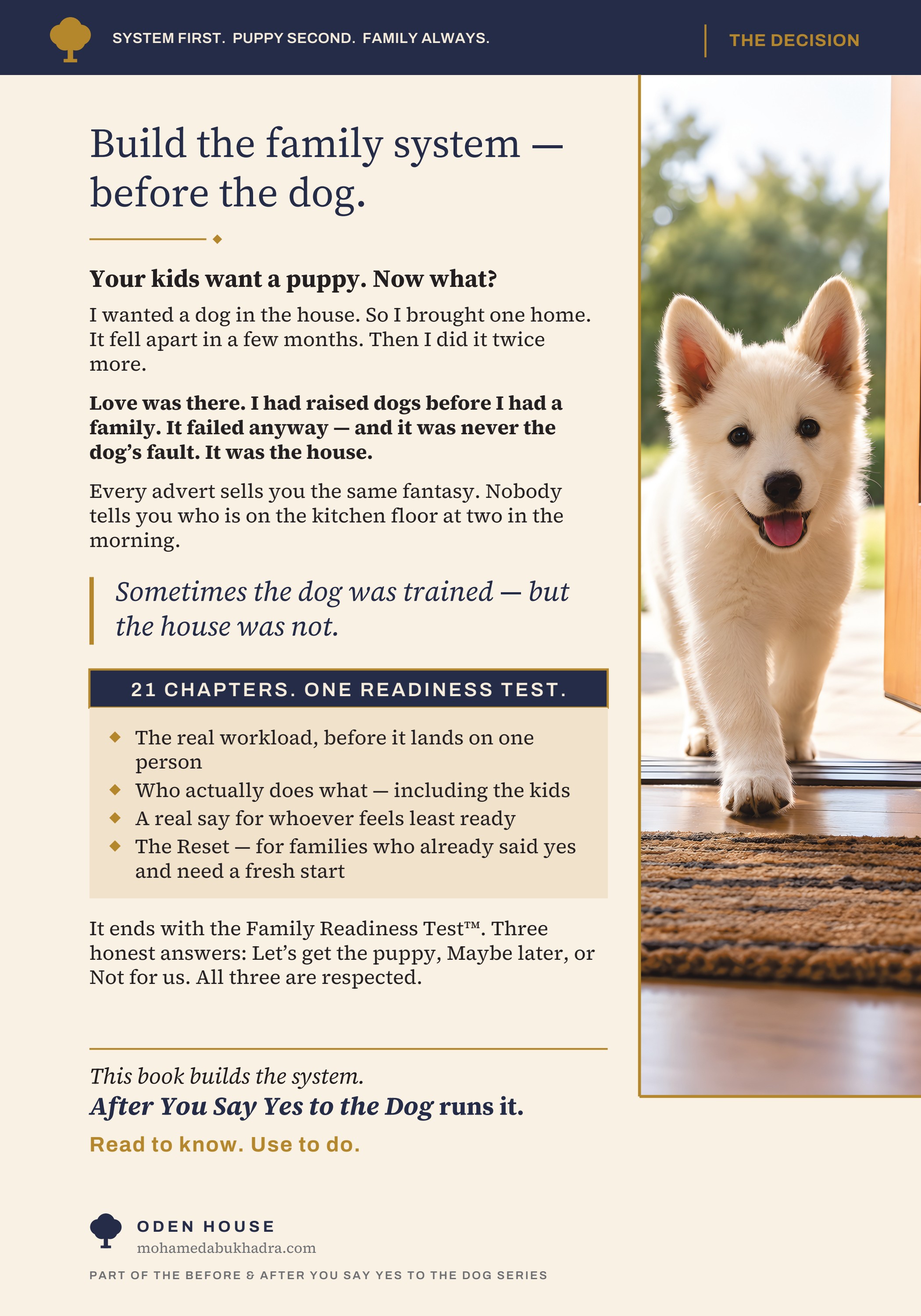
Before You Say Yes to the Dog
The decision framework and family operating system, ending at the Family Readiness Test.
Three lengths, in the third person, ready to paste into a programme, a feature or show notes.
Short · 66 words
Mohamed Abu Khadra is the author of Before You Say Yes to the Dog and After You Say Yes to the Dog. A management consultant in Cairo — former CEO of CowPay, and author of the first Egyptian case study in Philip Kotler’s Marketing Management — he failed three times to keep a dog before the fourth stayed. What changed was the household, not the dog.
Medium · 135 words
Mohamed Abu Khadra is the author of Before You Say Yes to the Dog and After You Say Yes to the Dog. He failed three times to bring a dog into his family home: three dogs, the same breed, each gone by month three. The children loved each one and had no rules; his wife was afraid of dogs and nobody had designed around that. Before the fourth dog he wrote a system for his own children, and that dog stayed. He is a management consultant in Cairo, former CEO of the payments company CowPay (Most Innovative Payment Solutions CEO 2023, MEA Markets), a visiting professor at RB College in the UK, and the author of the first Egyptian case study in Philip Kotler’s Marketing Management. He is not a trainer, and he says so.
Long · 288 words
Mohamed Abu Khadra failed three times to bring a dog into his family home — three dogs, the same breed, each gone within a few months. The children loved each dog and had no rules. His wife was afraid of dogs and nobody had designed around that. Each time, he rehomed a dog that had done nothing wrong. After the third, he stopped blaming luck and applied the discipline he uses at work: finding what is actually broken and designing a system that survives real life. The answer was not training. The house had no system. The fourth dog stayed. His name is Oden.
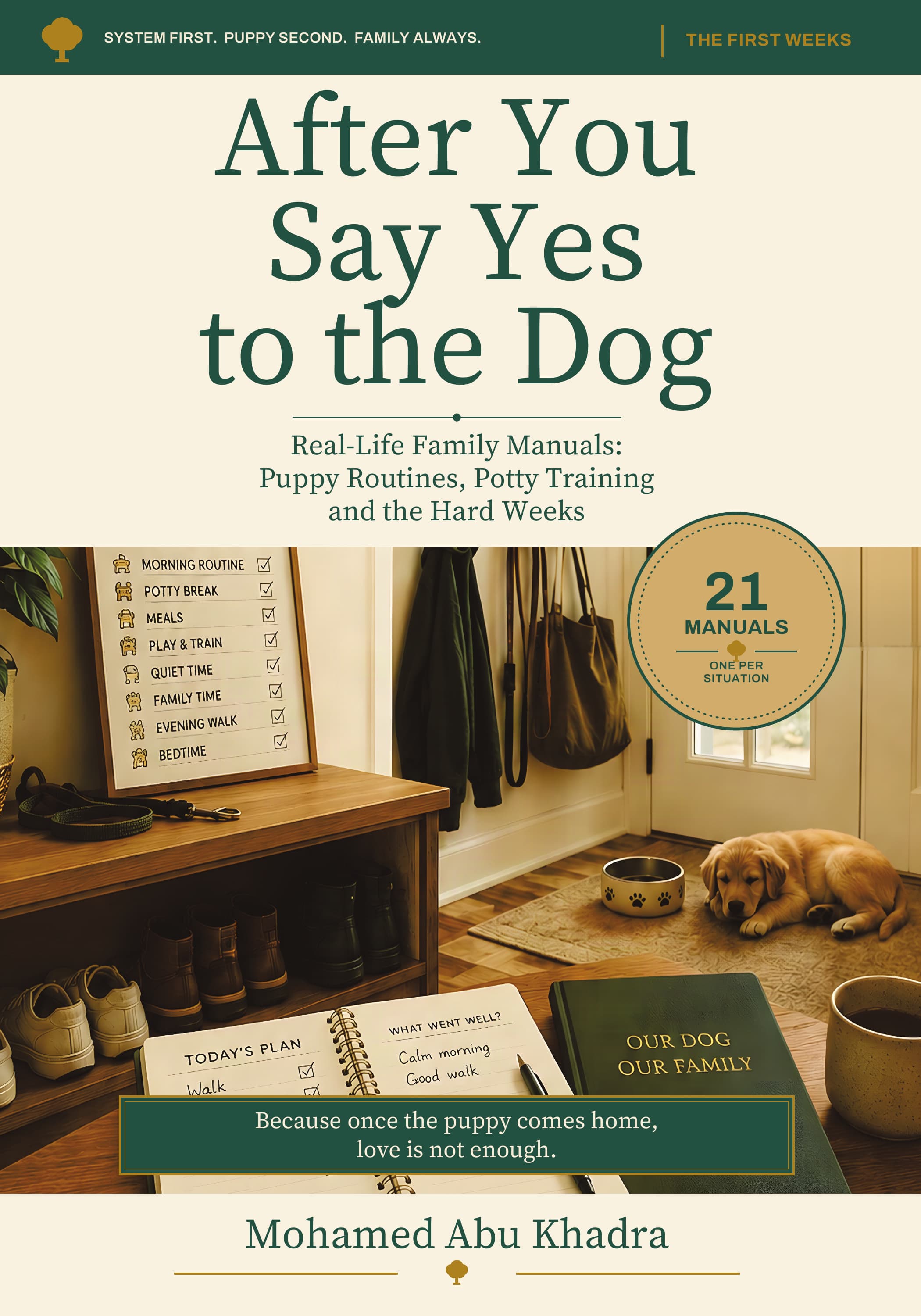
He is not a dog trainer, and that is the point. He is the author of Before You Say Yes to the Dog, a decision framework and family operating system that ends at the Family Readiness Test, and After You Say Yes to the Dog, twenty-one manuals, one per situation, for the family that has already said yes. He also publishes free printable guides for breeders, shelters, rescues, trainers and parents.
Before the books: twenty years running businesses as a management consultant and B2B marketer in Cairo. Former CEO of the Egyptian payments company CowPay, named Most Innovative Payment Solutions CEO 2023 at the MEA Markets Middle East CEO of the Year Awards. Author of the first Egyptian case study in Philip Kotler’s Marketing Management, with his name on the cover of its B2B Egypt Edition, and head of Kotler’s Ambassador Program in Egypt. Visiting professor at RB College, UK. Founder of Oden Pet, the practice software for canine behaviourists and dog trainers that carries the fourth dog’s name, and of The KnowHow Company. He lives in Cairo with his family and with Oden.
Pitch, for producers and hosts
In my house the person who had to live with the dog was afraid of dogs. Most dog books are written for the person who wanted him; mine are written for the house he moves into. I failed three times to keep a dog in my home before the fourth attempt worked, and what changed wasn't the dog or the training — it was the household. Most dogs that get rehomed were never failed by the dog. They were failed by a system nobody designed: who walks it at 6am on a bad week, who the dog actually listens to, whether both adults genuinely agreed. My book, Before You Say Yes to the Dog, applies process design to that question, and its final test will tell some families plainly: don't get a dog. I can talk about the partner who didn't want it, the mental load nobody counted, keeping children safe, and why "we'll figure it out" is the most expensive sentence in the house. Remote audio or video, any time zone.
Subjects I can cover
—The partner who did not want the dog — and the one who is afraid of dogs
—Why the house, not the dog, decides whether a puppy stays
—The mental load nobody counted: who owns seven in the morning and eleven at night
—What children can carry, and what stays with the adults
—The first three weeks: puppy blues, and why “try harder” is the wrong instruction
—A readiness test with three honest answers, including “Not for us”
—A puppy for Christmas: five questions before the deposit
—What trainers and shelters see every week that families miss
Suggested questions
You failed three times with the same breed. What was actually going wrong?
Your wife is afraid of dogs. How do you bring a dog into that house — and should you?
What is a “family system” for a dog, in one sentence?
Who should own the dog in a family — and what happens when everyone does?
What can a child of eight realistically do with a puppy, and what should they never be asked to do?
Most families hit a wall in the first three weeks. What should they do that week?
Your readiness test can tell a family “Not for us”. Isn’t that a hard thing for a book to say?
You are not a trainer. What do you say to the trainers reading this?
A puppy for Christmas — yes or no?
Figures journalists may use, with sources
Each figure names where it comes from, and links to it where there is a page to open. Where one is a survey rather than a journal paper, the line says so.
37.3% of caregivers found living with a puppy harder than expected. In the same study, 95% of puppies’ main adult carers were women.
Royal Veterinary College, 2025 (Belshaw et al., PLOS One 20(9): e0331179). RVC news release · The paper
Puppies sold before six weeks old typically had almost three more health problems by 21 months than puppies sold older (owner-reported, 985 UK puppies). 23.5% of owners spent more on vet care than they expected.
Royal Veterinary College, 2026 (Dale et al., Animal Welfare 35:e18). RVC news release
One in four new puppy owners said they had considered giving up their puppy within the first two weeks.
A Zigzag survey of 500 dog owners, reported by The Independent (AOL copy updated 5 November 2025). The report
Dogs given up to shelters had been owned for a median of 18 months, against about 32 months for matched pet dogs.
Powell et al., 2021, Frontiers in Veterinary Science 8:734973 (three US shelters). The paper
Nearly half of 1,572 Finnish dog owners reported significant negative feelings during their dog’s puppyhood. Among owners who had these feelings, about one in five said they lasted under a month and just over half under six months (20.3% and 51.3%).
Ståhl et al., 2024, University of Helsinki, npj Mental Health Research 3:27. The paper
When Wood Green, The Animals Charity, looked at 1,131 requests to give up a dog for behaviour, advice was accepted in 24.4% of them (276 cases).
Powdrill-Wells, Taylor and Melfi, 2021, Animals 11(10):2766. The paper
In a University of Central Florida survey of 379 partnered dog owners, more than four in ten said the dog had not been a joint decision.
Specific phobias affect roughly 7% of people at some point in life, and fewer than one in four people with one get any treatment.
Wardenaar et al., 2017, Psychological Medicine 47:1744.
Most dog bites to children happen at home and involve a dog the child knows.
Kahn et al., 2003, European Journal of Pediatrics 162:254; Reisner et al., 2011, Injury Prevention 17:348.
In a University of Lincoln study, more than half of three-year-olds misread a growling, snarling dog, and most of those who got it wrong thought the dog was happy.
Meints, Racca and Hickey, 2010, Injury Prevention 16 (Suppl 1): A68. The abstract